My personal car efficiency analysis
My first car was a hybrid, a 2009 second-generation Toyota Prius. For its time, it was meant to be efficient; it was shockingly minimal, with a Tesla-style, albeit tiny, touchscreen that controlled almost everything. Since then, I have owned several other cars and test-driven many EVs, but I always felt that there is more to efficiency than just MPG or miles per kWh. Here is my attempt to quantify it.
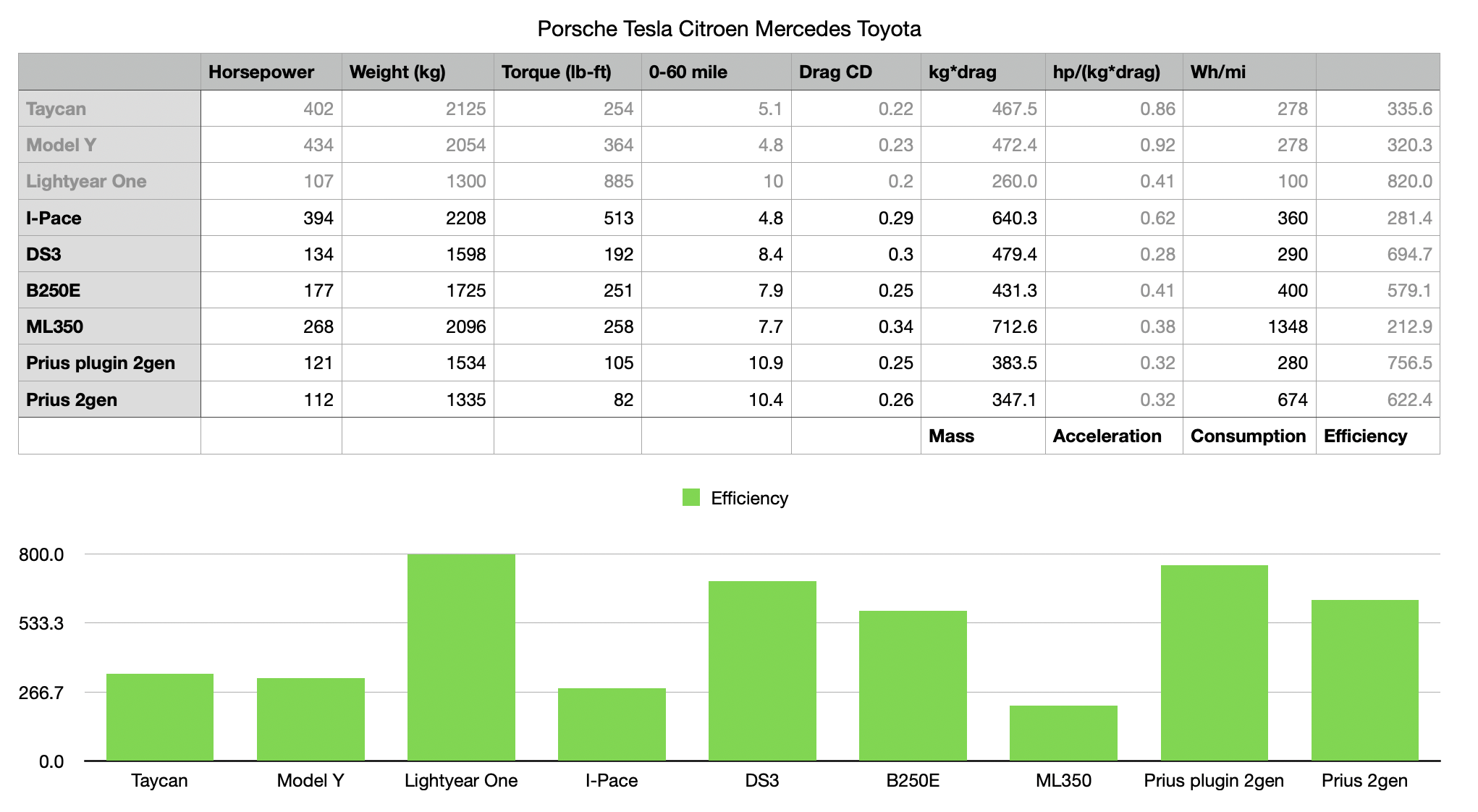
The Efficiency metric I created factors in everything except the acceleration in the chart above, and it closely matches my real-life experience with these cars.
I have owned all the ones that are not greyed out, and I always felt there was something to be said for how nimble models like the Prius felt—especially if you take their combustion engine out of the equation. For the three months that I owned the 2020 plug-in Prius, I ran it in EV mode 90% of the time, and it felt very lean; I was getting up to the advertised 4 miles per kWh.
The Mercedes-Benz vehicles (a 2006 ML350 and a 2015 B250e) were both very smooth even for their size. However, refined as the engineering in those cars might be, little thought was given to exactly how much running them would cost. They felt like they were built to last 100 years, but in some ways, that longevity is a bit of a waste.
The ML350 was a leather-and-wood-panelled tank that still managed to drive smoothly and quietly, but it had so much bulk. The sheer mass, combined with a mediocre drag coefficient, made it feel like the least efficient vehicle I ever drove.
The B250e, a Tesla-powered Frankenstein, took a solid car as a platform and added great battery and motor technology from Tesla, but the pairing compromised essentials like fast charging and range. The two together made the car unusable for anything other than grocery shopping in winter. In summer, there are only so many coffee breaks and walks you can take as you have to charge for an hour for every hour you drive. Basically, Mercedes did not really want this car to succeed, and while the aerodynamics were not too bad for a small SUV, the overall efficiency of only around 2 miles per kWh made the already small battery feel even smaller.
Moving on to the DS 3, which is my current daily driver: it is a well-balanced, light crossover. While a bit flimsy in places and lacking in the software department, it is nevertheless a very pleasant surprise and a solid EV, with up to 100 kW fast charging and almost 200 miles of range in summer. The drag coefficient is not great, and you don’t get a lot of internal space, but it still manages at least 3 miles per kWh in winter and close to 4 in summer. This is a testament to its lightness in the face of poor aerodynamics; the whole front grille is shared with its petrol counterpart and does not take advantage of the streamlining other EVs use.
The weight of the DS is very close to the more aerodynamic plug-in Prius, which uses weight-saving tricks like a carbon fibre boot lid. This shows how good that Prius could be with no hybrid engine and just a light battery and electric motor. But, of course, Toyota has no interest in doing that; it would be too good and show them to be the dinosaurs they really are, clinging to petrol for as long as they can.
I am guessing that a Prius Prime made fully electric, and with solar panels, would be close to the Lightyear One—the car that I admire most and have included here as the gold standard for efficiency, even if I haven't had the privilege of testing one yet.

I’ve included the Tesla and Porsche for comparison since I test-drove both. Compared to the Lightyear, which has a 170 Wh/kg figure (60 kWh in a 350 kg battery pack), the Taycan has an energy density of only 148 Wh/kg, and the Model Y stands at 141 Wh/kg (75 kWh in a 530 kg pack). This is soon to improve to 182 Wh/kg with the new structural pack of 4680 cells. Until that happens, both the Tesla and the Porsche are way too bulky, even with their decent aerodynamics, to rate too high on my efficiency scale. It is the updated generations of both that will hopefully tip the scales.
Driving them on the flat, they seem almost identical in their blazing-fast acceleration. It is in the corners and roundabouts that the Taycan shows its agility, but it is still a very large, bulky machine that could benefit from weight saving and minimalism like the Tesla (it weighs more than the Model Y SUV). The Taycan, for example, has two charging ports instead of combining AC and CCS into one port; it's an example of the lack of leanness present throughout, especially since you can’t use both charging points at the same time, which raises questions about their existence.
I have not driven or cared to include early "whales" like the Audi e-tron or Mercedes EQC because of their embarrassing inefficiencies. Those cars weigh 500 kg more than anything else on this list, with figures like 123 Wh/kg for the Mercedes battery pack and only 2.5 miles per kWh.