Can you hear torque vectoring? Regen downshifts, simulated gears and the next piece of EV feedback
In my last post, Torque vectoring, braking regen and other unsung EV tech, I looked at the clever systems in electric cars that nobody talks about. This one is about something closely related: how an EV tells you what those systems are doing. After a few years of driving electric, I've come to think sound is a big part of why some people never quite connect with these cars, and the industry seems to be catching on.
REGEN
The 2027 Porsche Taycan now offers E-Shift, an option with eight simulated gears worked through steering-wheel paddles. It's easy to dismiss as a gimmick, but the useful part isn't the fake gears. Each virtual gear has its own drag torque, comparable to the engine braking of a combustion car.
In practice, that gives you an eight-step regen control on the paddles. You can click down approaching a roundabout or junction, or on a long descent, to scrub speed without touching the brake, then click up to coast on the motorway.
As I explained in the last post, a "downshift" in an EV is really just a change in regen strength, since the motor can go from full drive to full regen almost instantly. What's been missing is a way to judge it.
SOUND
Once you get used to relying on regen rather than the brake pedal, you start to appreciate the subtle noises electric cars make. The Jaguar I-PACE has a really pleasing natural regen sound, like a downshift roar on whisper mode, and it tells you how hard the motors are harvesting. No synthesiser required.
I think the industry is starting to recognise that electric cars benefit from some form of audible feedback. The interesting split is whether you simulate it or amplify it.
1. Simulation (Porsche E-Shift)
Porsche has gone the simulation route: a virtual rev counter, noticeable shift jerks, gear-specific drag torque, a virtual rev limiter, and a synthesised soundtrack that adapts to the driving situation. It's credited openly to the car that started this trend, the Hyundai IONIQ 5 N.
2. Amplification (Ferrari Luce)
Ferrari went the other way with its first EV, the Luce. An accelerometer in the rear axle picks up the actual vibration of the motors and gears, then filters and amplifies it into the cabin, like an electric guitar pickup. It boosts the pleasant frequencies and strips out the whine and white noise, but never adds anything that isn't already there. It stays quiet in normal driving and only comes alive when you're pushing on.
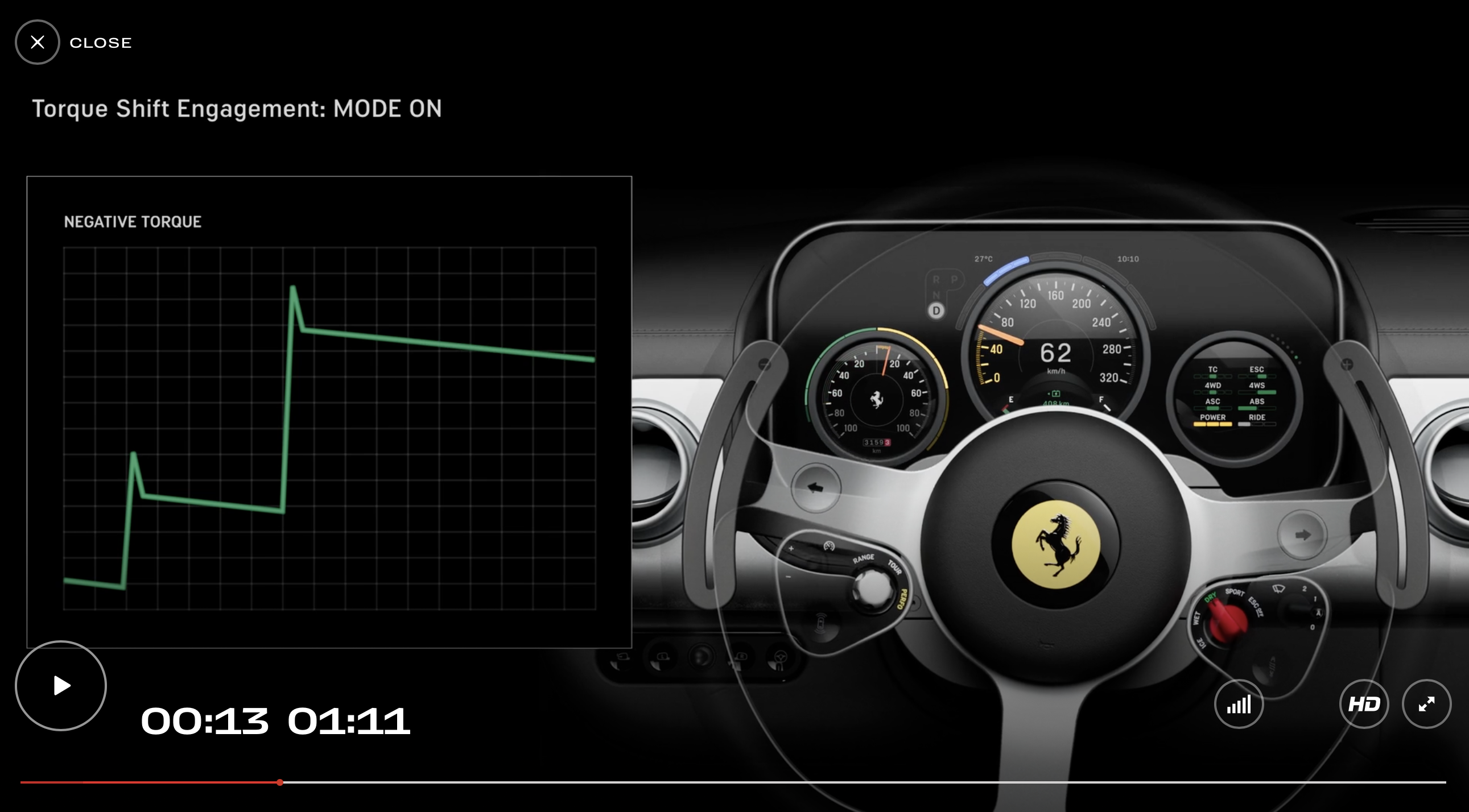
Its paddles don't fake a gearbox either. Ferrari calls the system Torque Shift Engagement, and it's five power levels on the right-hand paddle and five braking levels on the left, seamlessly modulating between acceleration and deceleration. When you pull a paddle, the torque profile changes rather than the motor speed, so the sound reflects what the car is really doing. I know that's a controversial take for a crowd that misses V8s (no pun intended), but to me this is the more honest approach.
VECTORING
Regen feedback is one thing, but I think audible torque vectoring could be one of the missing pieces in why we struggle to connect with electric cars.
Torque vectoring is almost entirely invisible. You feel the result, the car rotating into a corner, but you can't tell whether the system is helping you or quietly saving you. A sound cue would give you:
-
Limit awareness: if the cue gets busier through a corner, you're relying on the electronics more than you think. It's like tyre squeal, but earlier and more precise.
-
Learning on track: you could hear where you're asking too much of the car and adjust your line or throttle.
-
Low-grip warnings: it could flag heavy intervention in wet or icy conditions before anything feels wrong.
The hardware is already in the car. Modern cabins have enough speakers to position a sound spatially. If the torque vectoring controller shared its per-wheel torque commands with the audio system, you could map each corner to a speaker zone:
-
Location: the sound pans towards the wheel being driven harder or braked. Speeding up the outside rear in a left-hander would create a cue from the right rear.
-
Strength: volume or pitch scales with the size of the torque difference, so a small trim is barely audible while a big intervention near the limit is clearly noticeable.
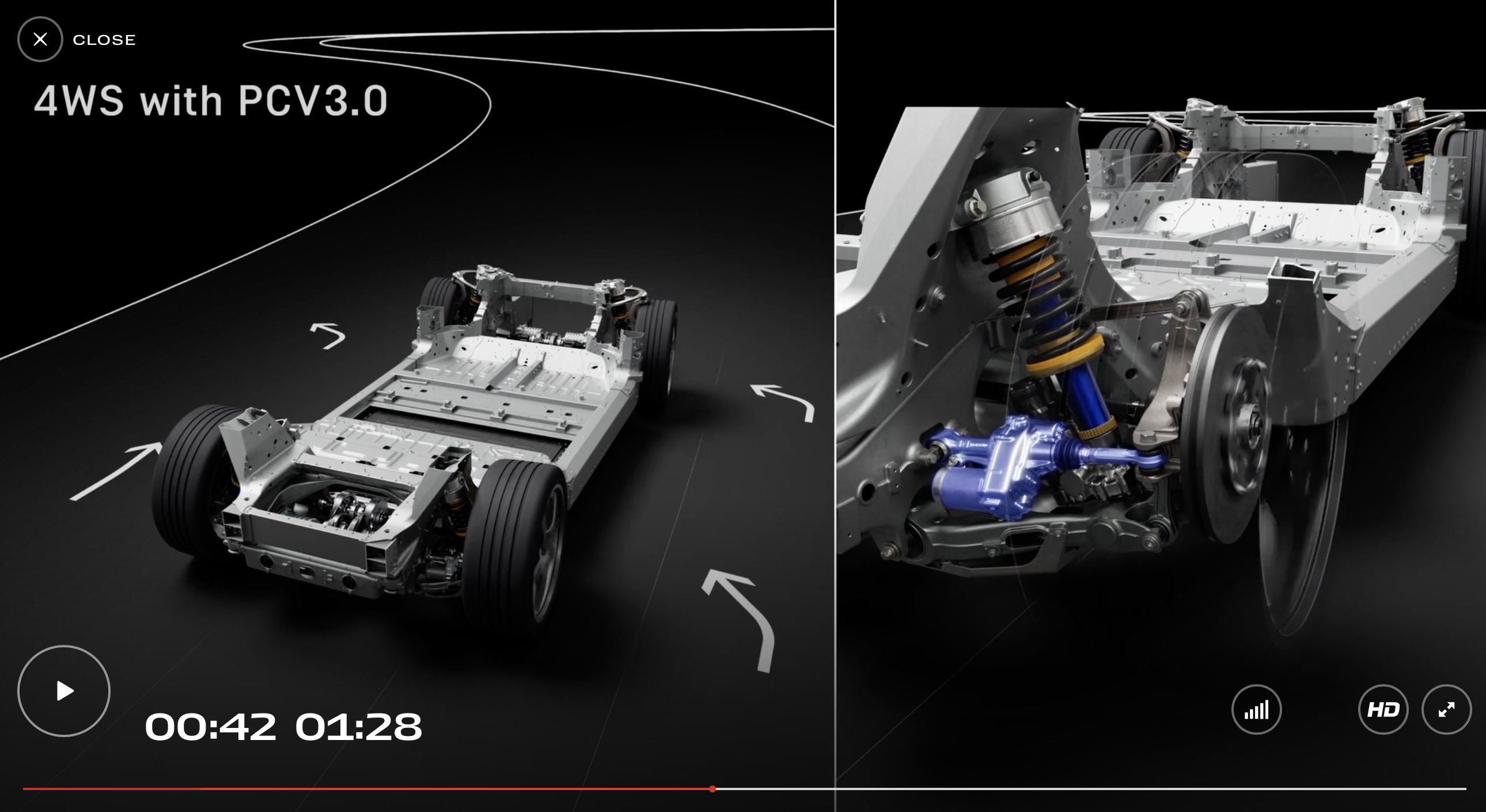
The Luce is a good example of why this is already possible. Each wheel is governed by three independent actuators, one for traction, one for vertical load and one for steering, so the car can deliver positive torque for acceleration and negative torque for energy recovery at each wheel independently, with rear-wheel steering fine-tuning tyre angle through the corner on top of that. That is precisely the per-wheel torque distribution a spatial sound cue would need to draw on.
PATENT
It turns out McLaren had the same idea. Its patent application EP4685788A1, "Vehicle cabin sound", filed with the European Patent Office in July 2025 and published in January 2026, describes:
A method for delivering audible feedback to a driver within a cabin of a road vehicle, the vehicle comprising a plurality of wheels and an electric motor coupled to at least one of the plurality of wheels and configured to drive the at least one of the plurality of wheels, the cabin housing a soundspace comprising a network of sound locations, the method comprising determining the torque delivered to at least two wheels of the plurality of wheels; determining a wheel torque distribution for the vehicle based on the determined torques; determining a primary sound location in the soundspace in accordance with the wheel torque distribution; and inputting the primary sound location to a spatial audio system, the spatial audio system being configured to deliver the audible feedback to the vehicle cabin such that the audible feedback is perceived by the driver to be originating from a virtual audio source located at the primary sound location.
In plain English: the car measures where the torque is going, and the sound follows it around the cabin. Importantly, it's based on torque distribution, not wheel slip, so it's a genuine torque vectoring cue rather than just a traction warning. It's still pending, and a patent is no guarantee of a production car, but it strongly hints at McLaren's electric future.
Going back to my last post, the types of vectoring would all sound different here. Multi-motor setups add torque to push the car round, while brake-based systems like the I-PACE's slow a wheel to help it turn. And a car like the Luce, with one traction actuator per wheel and a real pickup on the axle, could do all this authentically rather than synthesising it.
In conclusion, EVs were never short of clever engineering, just short of ways to tell the driver about it. Simulated gears give regen a familiar interface, amplified motor sound gives it an honest voice, and spatial torque vectoring cues could finally let you hear the chassis working underneath you. The first generation of electric performance cars made us feel the torque; the next might let us hear where it's going.